
NFDI at a Glance: Workshop Provided Guidance on Getting Started and Participating
Published on: October 19, 2026
The virtual “How to NFDI” workshop on 5 October 2026 demonstrated the many ways to engage with the German National Research Data Infrastructure (NFDI). Two NFDI sections and the NFDI4ING consortium provided insights into opportunities for participation, training and discipline-specific services.
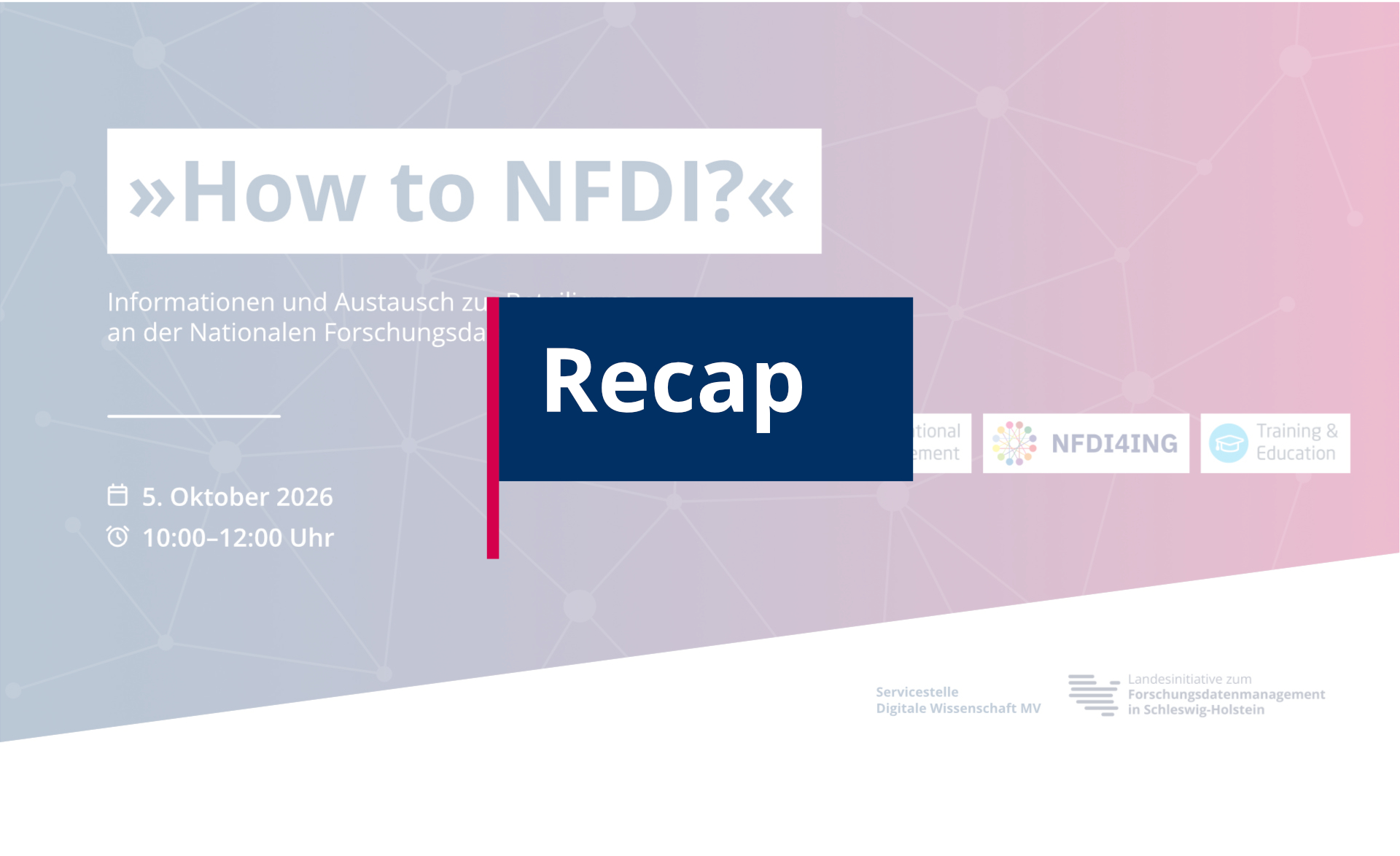
The two-hour workshop takes place once a year. In 2026, it was organised by FDM.SH, IG NFDI (https://fdm-sh.de/unsere-themen/nfdi/) and the Research Data Management unit of the Servicestelle Digitale Wissenschaft MV. Dr Julia Kobus attended the event as spokesperson for IG NFDI. The workshop was held as part of the collaboration between regional research data management initiatives and networks from Bremen, Hamburg, Mecklenburg-Western Pomerania, Lower Saxony and Schleswig-Holstein. It was aimed particularly at representatives of universities and non-university research institutions with limited prior contact with the NFDI and attracted strong participation from across Germany.
Dr René Ohlrau opened the workshop with an overview of the NFDI’s structure and opportunities for participation. The three subsequent presentations covered a range of topics, from cross-disciplinary collaboration within NFDI sections to the discipline-specific services offered by a consortium.
Building International Connections and Strengthening Skills
Dr Christiane Schneide introduced the International Engagement section (https://www.nfdi.de/sektion-international-engagement/), which was established in March 2026 as the NFDI’s sixth section. It focuses on European and international networking and creates opportunities for collaboration across consortia. Work has begun in the “Landscaping and Outreach” and “EOSC” working groups.
Dr Jens Dierkes highlighted the role of training in promoting responsible and FAIR research data management in his presentation on the Training & Education section (https://www.nfdi.de/section-edutrain/). The section brings together individuals involved in training from NFDI consortia, their partner institutions and other initiatives and networks. Its main priorities are exchanging experiences, improving the visibility of training opportunities and harmonising competency profiles across all career stages. This also includes developing approaches to quality assurance for training materials and formats.
Discipline-Specific Services for Engineering
Klara Diester introduced NFDI4ING (https://nfdi4ing.de/) as a discipline-specific approach to the NFDI. The diversity of research data, methods and disciplinary cultures in engineering presents particular challenges for sustainable research data management. NFDI4ING brings together different disciplinary communities and supports them in making research data accessible and reusable in accordance with the FAIR principles, under licences that are as open as possible and in a citable form.
The presentation provided an overview of services and support for finding, publishing and reusing research data and research software. Training and professional development opportunities also aim to strengthen data literacy across all career stages and support a sustainable cultural change in research data management.
Different Pathways into the NFDI
The workshop highlighted two distinct but interconnected ways of engaging with the NFDI: sections provide opportunities for collaboration across disciplines and institutions, while consortia bring together discipline-specific communities, services and training opportunities. For representatives of universities and research institutions, the event offered a concise overview of where they can contribute to cross-cutting topics and where they can access discipline-specific support.